A four-year review of spending and events
The email opens with what it calls a review of donor-dollar use and agency practices from 2022 through 2025. It presents its chronology as evidence that the board approved, tolerated, or failed to challenge organizational decisions. That is the newsletter's argument; the archive does not independently determine what the board reviewed, what individual directors knew, or how particular expenditures were authorized.
Events highlighted from 2025
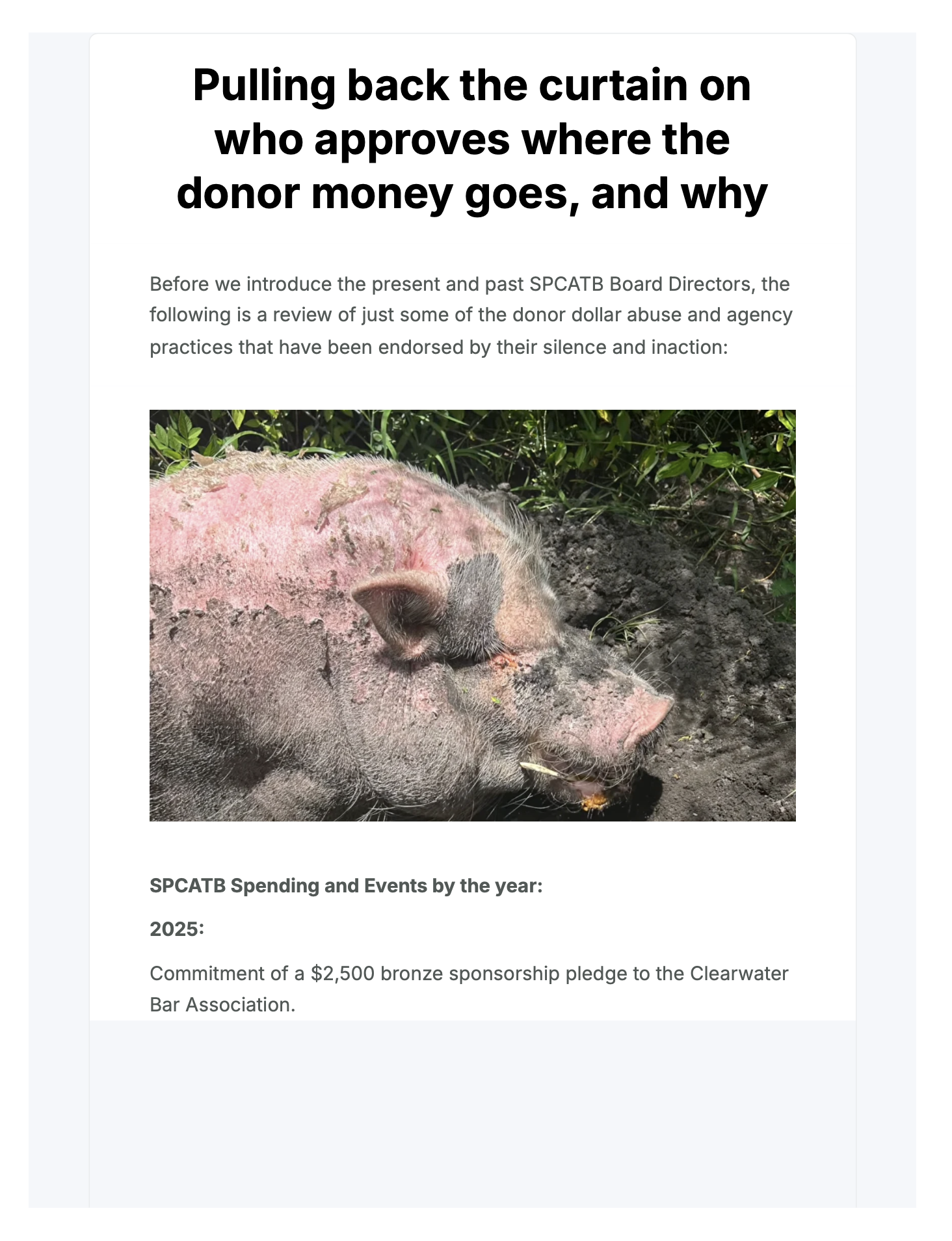
For 2025, the newsletter highlights a reported $2,500 bronze sponsorship pledge to the Clearwater Bar Association. It contrasts that expense with Waddles' condition and criticizes SPCA Tampa Bay's response to the animal-cruelty case.
The email also refers to the departure of veterinarian Cynthia Mitchell, the continued employment of CEO Martha Boden, SPCA Tampa Bay's effort to vacate its guilty plea, and the use of Largo police and private security during a Pet Walk attended by protesters. It links to media coverage and a petition demanding the CEO's resignation.
Descriptions of the legal case and the motives behind institutional decisions are presented from the newsletter authors' advocacy perspective. Readers should consult court records, official statements, and contemporaneous reporting when evaluating those claims.
Financial figures presented for 2022–2024
The newsletter attributes the following annual figures to SPCA Tampa Bay's tax filings. It converts fundraising expenses into weekly, daily, and hourly amounts and compares selected compensation figures from year to year:
- 2024: $1,542,775 in fundraising expenses; $190,662 in CEO salary and compensation; and $1,085,069 for eight executive administrators
- 2023: $1,416,695 in fundraising expenses; $173,882 in CEO salary and compensation; and $974,597 for seven executive administrators
- 2022: $1,317,130 in fundraising expenses; $178,844 in CEO salary and compensation; and $913,037 for four executive administrators
These numbers are reproduced here as figures stated in the email, not as an independent financial audit. Comparisons across Form 990 filings can depend on fiscal periods, compensation definitions, employee groupings, and the treatment of benefits or related organizations. Readers should review the original filings before drawing conclusions.
Consulting, public funding, and institutional priorities
The email says St. Petersburg Council member Gina Driscoll received payments described as contracted development work involving introductions, information sharing, or staff training: $11,688 in 2022, $40,539 in 2023, and $42,000 in 2024. It states that the three-year total was $94,227 and questions why a public official received consulting fees from donor-funded resources.
The newsletter also discusses a reported $750,000 state funding request for shelter-campus renovation, criticism involving speech at a public park, SPCA Tampa Bay's relationship with commercial puppy-industry participants, its withdrawal from a county spay-and-neuter voucher program, and a reported $4.05 million sale of its veterinary clinic.
The email interprets these matters as evidence of misplaced priorities and asks whether resources could have been used differently. This archive does not independently verify the stated payments, the terms or results of any contract, the disposition of public funds or sale proceeds, or the reasons for the organization's program decisions.
Questions posed by the newsletter
The authors ask why fundraising expenses and executive compensation increased, why outside consulting was used, why the Clearwater Bar Association sponsorship was funded, why low-cost spay and neuter was not promoted more aggressively, and whether the veterinary-clinic sale was connected to administrative or contractor costs.
What records would allow donors to evaluate whether spending, compensation, contracts, and asset sales advanced the organization's stated mission?
These are legitimate subjects for public inquiry, but the newsletter often states or implies an answer in accusatory terms. Questions about nonprofit governance should be distinguished from proof of waste, self-dealing, corruption, or individual misconduct.
Additional directors identified in the email
Continuing the board discussion from Email 04, the newsletter identifies the following people as remaining members of the 2025 board whose names, it says, were later removed from the SPCA Tampa Bay website:
- Dick Caldwell
- Will Freeman
- Naomi Harker
- Merissa Lynn
- Stephanie Morge
- Rachel Menger
- Carrie O'Brion
- Rhoda Restivo
- Julie Rockwell
- Stacy Nethercoat
- Erin Maloney
- Sosha Lohn
The original includes portraits and brief descriptions of several individuals' professional roles in law, communications, training, mental health, higher education, finance, wealth management, technology, government communications, and law-enforcement labor relations. Those affiliations are historical claims attributed to the April 30, 2026 email and may have changed.
The email later uses both “Sosha Lohn” and “Sasha Lohn.” This summary retains “Sosha Lohn” from the board list rather than attempting to resolve the discrepancy. Readers should use current official sources to verify names, board service, and employment.
Departures and the newsletter's board critique
The newsletter states that, as of October 10, 2025, Erica Maxwell, Naomi Harker, Sosha Lohn, Erin Maloney, Rachel Menger, Stacy Nethercoat, and Catherine Mitchell were no longer listed on the organization's website. It asks whether the changes reflected ordinary board turnover or reputational pressure associated with the Waddles controversy.
No evidence presented in the readable text establishes why any particular person left or was removed from a website listing. Timing alone does not establish motive, and the email's suggestion of a “mass exodus” should be treated as advocacy commentary unless supported by board records or statements from the individuals involved.
The email argues that directors failed to hold administrators accountable and criticizes them for silence or inaction. Board membership does carry oversight duties, but it does not, by itself, establish that every director possessed the same information, supported every operational decision, or bears personal legal responsibility for Waddles' treatment.
The closing call for scrutiny
The newsletter closes by describing animal welfare as a multimillion-dollar field vulnerable to exploitation through marketing and emotional appeals. It asks readers to examine who controls donated money, how organizational narratives are constructed, and whether leaders respond when public confidence is damaged.
It thanks readers for raising awareness and announces that the next installment will examine evidence concerning Waddles' treatment ahead of a May 13, 2026 pretrial hearing.
Email 05 — Pulling Back the Curtain on Donor Spending and Board Oversight
About the archived original
The original is a 17-page PDF dated April 30, 2026. It includes a Waddles photograph, screenshots, news and commentary links, spending and compensation figures, portraits of named board members, stated professional affiliations, rhetorical questions, and subscription material.
The email identifies Forms 990 for 2021, 2022, 2023, and 2024 as sources. This readable version summarizes the document while preserving attribution and avoiding unnecessary repetition of its strongest accusations. The complete original PDF remains available for archival review.