The board's role
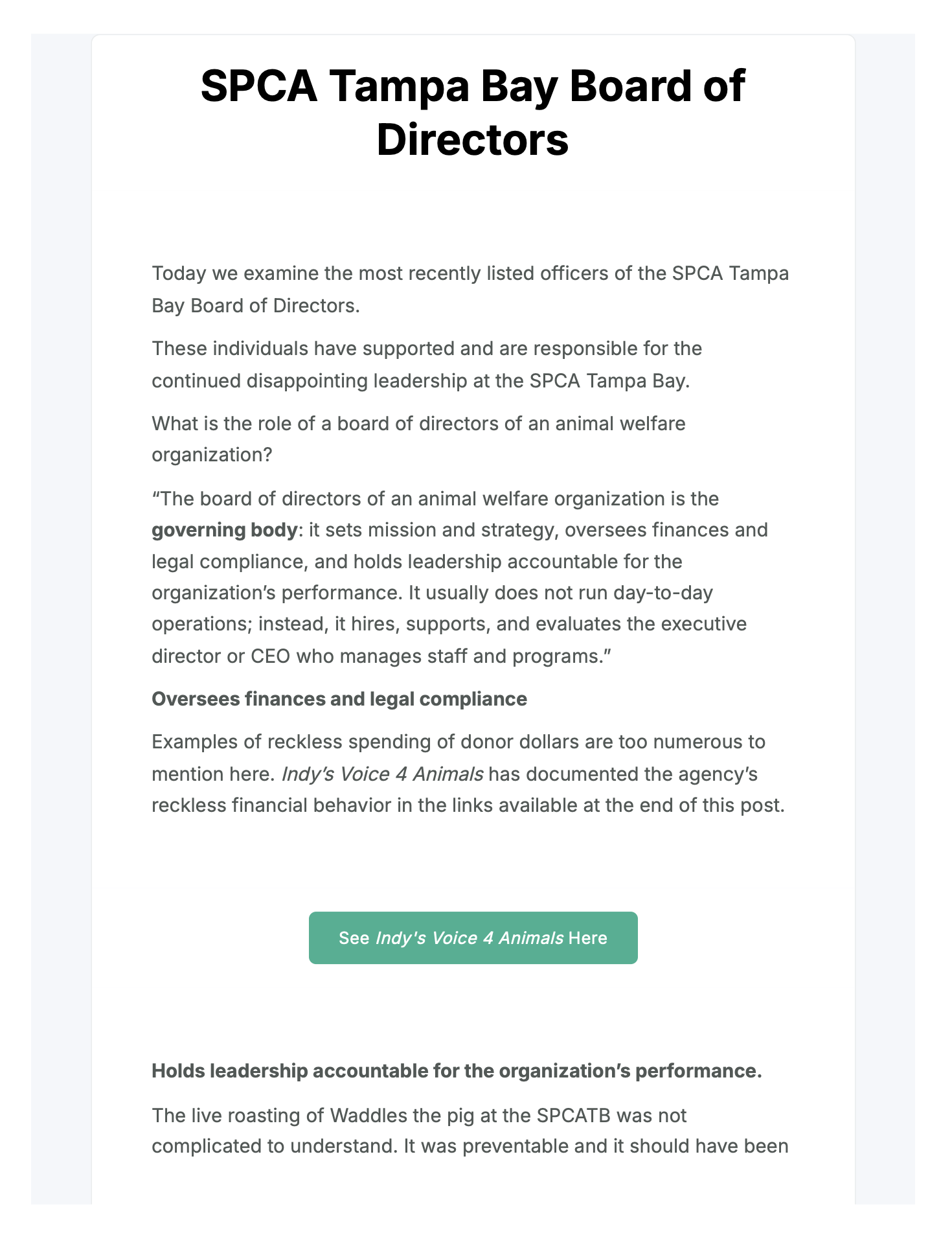
The email begins by asking what a board of directors is expected to do within an animal-welfare organization. It describes a board as the governing body responsible for setting mission and strategy, overseeing finances and legal compliance, and holding executive leadership accountable for organizational performance.
It distinguishes governance from daily operations: directors ordinarily do not manage staff or programs themselves, but they hire, support, and evaluate the chief executive who does.
When a serious institutional controversy develops, what information should a governing board seek, what action should it consider, and how should it explain its decisions to the public?
Financial oversight and outside commentary
The newsletter criticizes SPCA Tampa Bay's financial priorities and directs readers to articles published by Indy’s Voice 4 Animals. Those criticisms are the newsletter's and the outside publisher's interpretations; this archive page does not independently validate their conclusions.
The linked articles address alleged political influence, guidance directed to SPCA Tampa Bay directors, and interpretations of compensation figures reported in the organization's tax filings.
The newsletter's argument about Waddles
The email argues that Waddles' condition presented a governance crisis requiring a prompt board response. It says directors should have evaluated executive leadership after SPCA Tampa Bay received an animal-cruelty citation and as the case generated legal proceedings, public criticism, and local and national media attention.
The newsletter contends that the board should have considered whether CEO Martha Boden ought to step down or be removed. That is the authors' advocacy position, not a finding that the board was legally obligated to reach a particular personnel decision.
It also links the board's alleged inaction to broader public concern involving the Largo Police Department, the State Attorney's Office, and the Largo city administration. The original refers to an Internal Affairs complaint and asks why the controversy was not resolved earlier. Filing a complaint does not itself establish wrongdoing, and this archive page does not independently determine the status or merits of any such complaint.
Officers identified in the email
The newsletter identifies the following people as recently listed officers of the SPCA Tampa Bay Board of Directors. Titles and professional affiliations below are attributed to the April 23, 2026 email and may have changed:
- Tina Thomas — Board Chair; identified as a senior vice president of operations at Mission Health Communities
- Catherine Mitchell — Past Board Chair; identified as working at Dynasty Financial
- Trevor Tillwick — Secretary; identified as an executive at Molina Healthcare
- Dr. Julie Kessel — Treasurer and Finance Committee Chair; identified as principal at Tevunah Clinical Insights
- Erica Maxwell — Governance Chair; identified with the American Heart Association
The readable archive does not reproduce the direct email addresses or portraits included in the original. Readers seeking to verify current board membership or employment should consult current official sources rather than treating this historical email as a current directory.
Questions directed to individual officers
The newsletter addresses a rhetorical question to each named officer. Those questions draw analogies between the Waddles controversy and the officer's stated professional field, including healthcare operations, communications, corporate growth, clinical care, and heart-health advocacy.
The questions are accusatory in tone and are intended to challenge the officers publicly about oversight and silence. They do not, by themselves, establish what any individual knew, when they knew it, what authority they exercised, or whether they participated in a particular operational decision.
The closing call for accountability
The email closes by arguing that board titles carry continuing responsibility and that the public is entitled to ask who could act, what decisions were made, and why. It announces that later installments will examine additional current and former directors.
The original escalates from governance questions into forceful accusations of responsibility and complicity. Those are the newsletter authors' conclusions, not adjudicated findings. A legally careful reading should distinguish legitimate public questions about nonprofit governance from unproven claims about any named person's individual conduct or intent.
The newsletter thanks readers and asks them to continue raising questions about the intersection of animal welfare, organizational leadership, and public institutions in Pinellas County.
Email 04 — Accountability Starts at the Top: Meet the SPCA Tampa Bay Board
About the archived original
The original is a 10-page PDF dated April 23, 2026. It includes photographs, board titles, stated professional affiliations, direct email addresses, individualized rhetorical questions, links to outside commentary, and subscription material.
To avoid unnecessarily republishing contact details and to preserve the distinction between advocacy and established fact, this readable version summarizes rather than reproduces the email's strongest accusations. The complete original PDF remains available for archival review.