Thanks to readers and a request for continued scrutiny
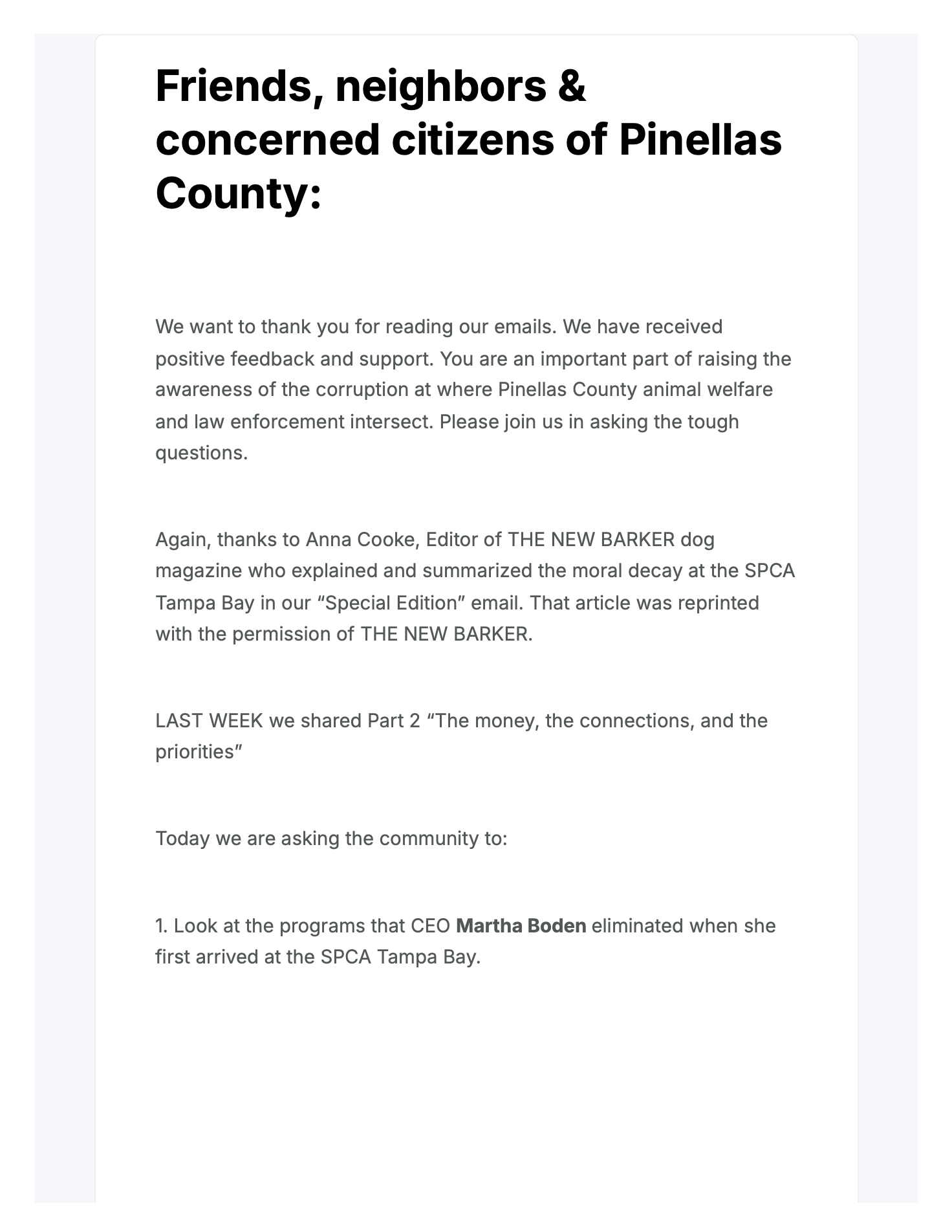
The email opens by thanking readers for their feedback and support. It urges Pinellas County residents to continue asking difficult questions about the intersection of animal welfare and law enforcement.
It also again thanks Anna Cooke, editor of The New Barker, for commentary republished with permission in an earlier special-edition email. After referring to Part 2, which focused on money, connections, and priorities, this installment identifies two subjects for closer examination.
First, it asks readers to look at programs the newsletter says Martha Boden eliminated after arriving at SPCA Tampa Bay. Second, it questions the roles of Largo Police Chief Mike Loux and State Attorney Bruce Bartlett in the events surrounding a potential arrest in the Waddles case.
Programs the email says were discontinued
The newsletter characterizes SPCA Tampa Bay as having shifted toward fundraising while reducing services that once helped animals and pet owners in the community. That characterization is the authors' advocacy position and should be read as such.
According to the email, programs or services discontinued after Boden's arrival included:
- Low-cost or free spay and neuter services for low-income residents
- Trap-neuter-vaccinate-return services for community cats
- Off-site adoption and education programs
- Senior-pet adoption initiatives
- Dog and cat behavior education intended to prevent surrender
- Volunteer programs for cats and dogs
- A behavior hotline and animal-food assistance
- Temporary care for pets connected to people in volatile or unsafe situations
- A 24-hour emergency animal ambulance and care for injured strays
- Emergency veterinary assistance for low-income families
- Disaster response, humane investigations, school education, and summer-camp programs
The email argues that many of these services had helped prevent abandonment or surrender and had formed an important part of the organization's earlier community mission.
Accounts from former staff and volunteers
The newsletter attributes several statements to Donna Bainter, identified in the email as a former director of behavior and training and a 20-year SPCA Tampa Bay employee. Her attributed account describes staff terminations, the dismissal of longtime volunteers, and the dismantling of programs she believed had made the shelter a place of hope and care.
The email also attributes a statement to former volunteer Terasa VanCoppenolle criticizing the priorities of the organization's newer leadership. These are attributed personal accounts reproduced in the source; this archive page does not independently verify them.
The authors question whether donors understood that some services had ended and encourage readers with questions about those decisions to seek answers directly from SPCA Tampa Bay leadership.
Questions surrounding the Waddles investigation
The second half of the email returns to Waddles. It describes the severe injuries shown in photographs after he was exposed to the sun at SPCA Tampa Bay in July 2025 and states that an investigating officer reportedly believed there was probable cause for an arrest.
The newsletter claims that the officer was removed from the case while en route to carry out an arrest. It then asks who made that decision and why the contemplated arrest did not proceed. These claims and questions were part of the advocacy record at the time; they are not presented here as final judicial findings.
The authors say public statements appeared to direct responsibility among Largo Police leadership, the State Attorney's Office, and the Largo city administration. The email describes this as circular finger-pointing and argues that the public had not received a clear account of the decision-making process.
Reported internal-affairs inquiry
The email states that an internal-affairs investigation had reportedly been opened involving the Largo Police Department, including Chief Mike Loux. It treats that reported inquiry as a reason to seek further information about oversight and decision-making.
An internal investigation, by itself, does not establish wrongdoing. The email nonetheless argues that the public should receive clear answers about the status and scope of any inquiry and the steps being taken in response to the concerns raised.
Who decided to remove the investigating officer from the case, and what was the stated basis for that decision?
What was the status and scope of the reported internal-affairs investigation?
What steps, if any, were being taken to address the concerns raised by residents and animal advocates?
The email's closing message
The newsletter closes by directing questions to named public officials and previewing Part 4, which it says will examine past and present SPCA Tampa Bay directors. It also tells readers to expect another special-edition article.
The central argument of Email 03 is that discontinued services, leadership decisions, and the handling of the Waddles investigation should be examined together rather than viewed as isolated events. The authors call on readers to seek specific, documented answers from the institutions involved.
Email 03 — The Umbrella Effect
About the archived original
The original file is a 10-page PDF dated April 8, 2026. Its embedded PDF title is “Programs Extinguished. Leadership Questions Remain. Answers Needed.” The archive identifies the record as “The Umbrella Effect,” consistent with the supplied file name and archive title.
The original includes photographs, attributed quotations, email addresses for public officials, and subscription material. To keep this readable version focused—and to avoid unnecessarily republishing contact details—the full contact section is not reproduced here. The complete PDF remains available for archival review.